

[ad_1]
Would you consider it if we stated there’s one other expertise that boasts simply as many use instances as blockchain?
Certainly, blockchains aren’t the one decentralized programs as generally perceived.
Applied sciences like Direct Acyclic Graph (DAG) are respiratory new life into the cryptocurrency world.
Whereas sharing loads of similarities with blockchain, DAG tech is rising as the following step within the evolution of decentralized programs.
So, let’s discover out on this article what they’re, their design to suit the real-world use instances, and the way they distinction with blockchain.
Let’s go!
Overview of DAG
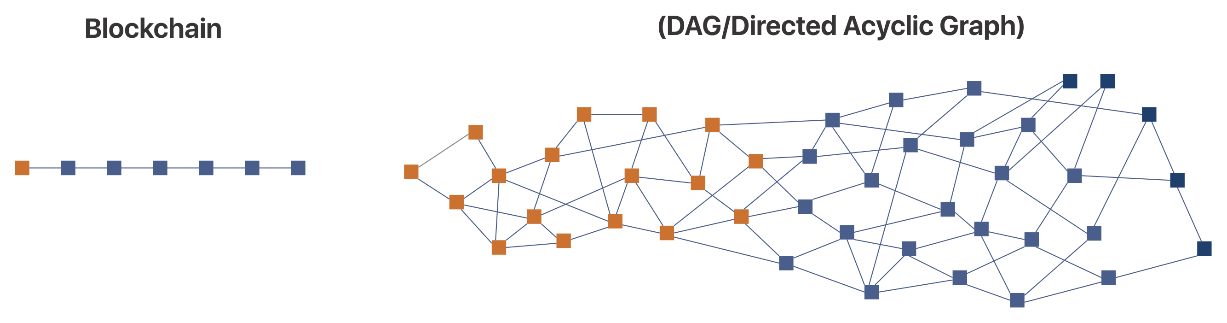
DAG expertise, or directed acyclic graph, is an method to organizing and dealing with information, significantly in cryptocurrencies. It is sort of a system of linked dots moderately than blocks in a blockchain. As an alternative of blocks, you’ve got vertices and edges.
Transactions in DAG are represented as these vertices, and so they’re stacked upon each other. Identical to in a blockchain, nodes add transactions, however right here, nodes have to carry out proof-of-work duties to submit a transaction.
The massive distinction? Whereas blockchains resemble a linear chain, DAG seems to be extra like a community of factors. DAG is gaining higher curiosity as a result of it’d resolve some points in blockchain programs. With DAG, miners received’t be competing so as to add new blocks, and since nodes may be created concurrently, transactions may be processed quicker.
Now, how does it really work?
- The DAG Setup: Think about an online, not a sequence, dealing with transactions in a brand new system referred to as DAG. It’s like a tree with nodes (transaction factors) linked throughout. What’s extra fascinating right here is these nodes can hyperlink to a number of others, permitting a lot of transactions to occur on the identical time.
- Referencing the Previous: So, for a brand new transaction to be legit, it should level again to older ones, very like blocks in a blockchain seek advice from earlier ones. The thought is {that a} transaction is simply validated when it’s referenced by one other, creating a sequence of confirmations.
- No Blocks: Every transaction is a vertex in a DAG, and there are not any blocks. No mining is required, both. Transactions simply construct on prime of one another, and proof-of-work duties occur when a node submits a transaction to validate those earlier than it and stop spam.
- Extra Connections, Extra Choices: In contrast to blockchains that stick to 1 earlier block, DAG-based transactions can level to a number of previous ones. Some programs even use algorithms to decide on which transactions to construct on based mostly on their weight or the variety of confirmations acquired.
- Verifying Path to the Begin: To keep away from double spending, nodes verify older transactions by following a path again to the primary transaction within the DAG. This verifies if the sender has sufficient stability. If somebody tries to construct on an invalid path, their transaction may get ignored.
- Resolving Conflicts: When paths collide, an algorithm steps in, favouring transactions with a extra stable historical past. This algorithm ensures the system stays on observe.
The Dominating Benefits of DAG Expertise
Lightning-fast Transactions
Probably the most note-worthy attributes of DAG tech is its fast transaction pace. Its construction permits for concurrent transaction approval, enabling customers to provoke and obtain confirmations concurrently.
Dealing with A great deal of Transactions
DAGs boast a superior throughput, processing a exceptional variety of transactions per second (tps). In contrast to conventional blockchains constrained by block technology occasions, DAGs effortlessly scale as extra individuals be part of.
Unparalleled Efficiency
In contrast to conventional blockchains that have congestion and efficiency degradation throughout spikes in transaction quantity, DAG networks thrive beneath elevated visitors. Because the transaction load surges and consumer engagement intensifies, DAG programs exhibit improved efficiency.
Value-Efficient
The omission of the miner validation considerably reduces transaction charges inside DAG networks. This streamlined course of allows extra transactions to be accommodated with out the concern of escalating charges.
Power-conscious
DAG protocols keep away from the energy-intensive PoW consensus mechanism, setting them aside as eco-friendly alternate options to PoW-based blockchains. As cryptocurrencies like BTC face scrutiny relating to their affect, DAGs supply an answer by considerably lowering vitality consumption.
Versatile Implementation
DAGs exhibit versatility past forex purposes. Their compatibility with numerous consensus mechanisms permits seamless integration into numerous sectors corresponding to IoT, provide chains, and different specialised domains.
Altogether, their scalability and resilience make DAG supreme for platforms anticipating excessive transaction volumes.
DAG vs. Blockchain – Analysing Their Technical Distinction
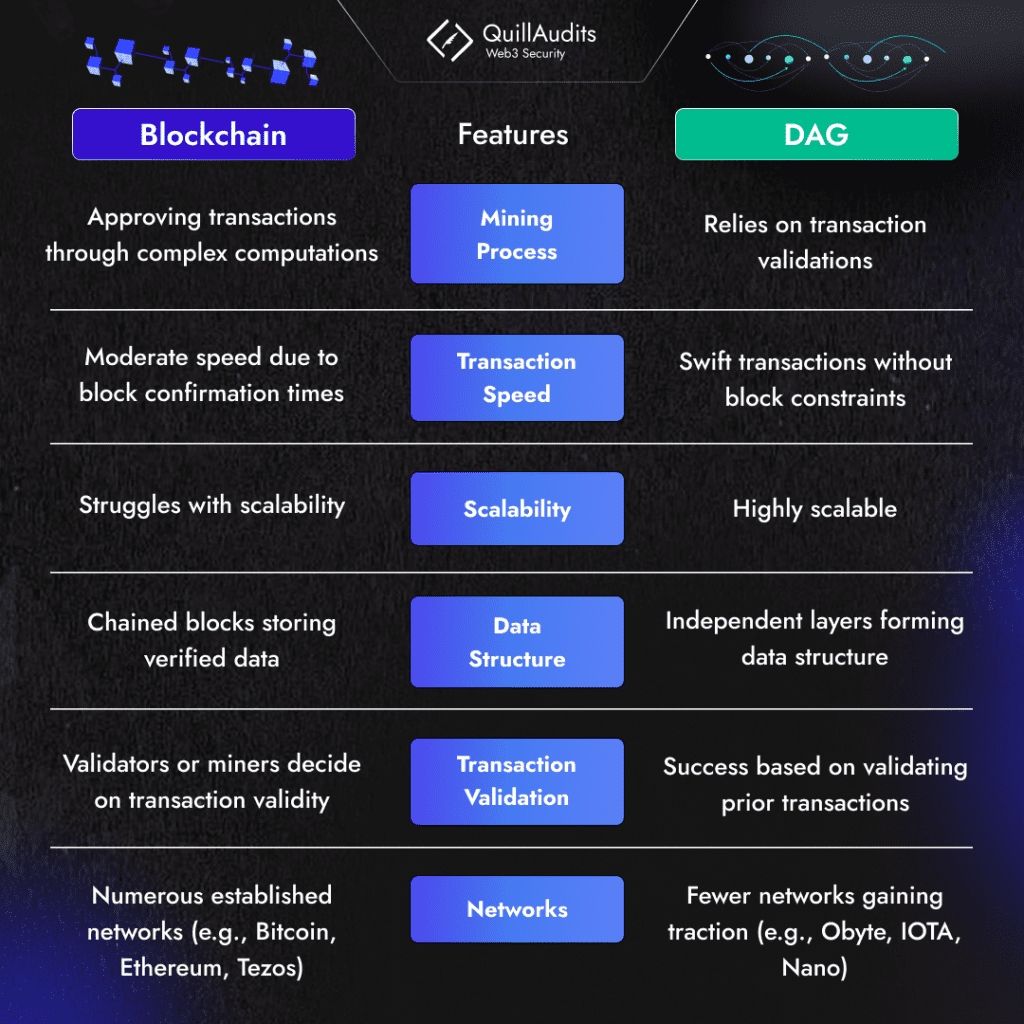
- Mining: Approving Transactions vs. Transaction Validation
In blockchain, mining entails approving transactions and creating new cash via advanced computations. Miners verify and add transactions to blocks, incomes tokens in return.
In distinction, DAG’s consensus depends on earlier transaction validations. Transactions acquire consensus by referencing prior ones with substantial weight.
- Transaction Pace: Absence of Blocks vs. Scalability
Blockchains are recognized for pace, however DAGs take the lead. With out block or wait occasions, DAGs guarantee swifter transactions.
Whereas blockchain struggles with scalability, DAG’s distinctive construction permits for a excessive quantity of transactions, enhancing scalability.
- Information Construction: Chained Blocks vs. Unbiased Layers
Verified information resides inside linked blocks in blockchains, forming an countless chain. In DAG, information is saved independently, creating layers on prime of one another.
- Transaction Validation: Miner Choice vs. Approval of Earlier Transactions
Blockchains depend on miners or validators to resolve on transaction validity. In DAG, a transaction’s success hinges on its capability to validate prior transactions.
- Networks: Broad Blockchain Adoption vs. Restricted DAG Networks
Bitcoin, Ethereum, and Tezos are among the many many blockchain networks. In distinction, DAG networks like Obyte, IOTA, and Nano are fewer however gaining traction.
DAG-powered Initiatives
TARAXA
- TARAXA incorporates BlockDAG expertise to reinforce scalability whereas sustaining strong safety measures.
- This implementation permits for top throughput, surpassing 5,000 TPS.
- It has outlined a roadmap with formidable plans to raise its efficiency additional, aiming for a powerful 50,000 TPS.
IOTA
- IOTA stands out with its utilization of Tangle, a DAG-based construction aimed toward overcoming the restrictions of conventional blockchain architectures.
- Tangle’s design facilitates near-instant, fee-less transactions, supreme for IoT purposes.
- Its multidimensional construction fosters interconnected transactions, eliminating the necessity for separate blocks or chains and enhancing scalability and efficiency.
- The platform’s testnet has demonstrated spectacular scalability, attaining over 10,000 TPS.
Nano
- Nano adopts the revolutionary block-lattice framework, a hybrid combining DAG ideas with conventional blockchain. This construction permits for impartial blockchains for every consumer inside the community.
- Nano’s structure allows simultaneous transactions of any dimension with out incurring community charges.
- Every consumer manages their very own blockchain, offering a excessive diploma of autonomy and safety. Nano prioritizes high-speed transactions and 0 transaction charges.
Last Ideas
Contemplating the panorama we’ve explored, each blockchain and DAG showcase strengths and variations. It’s not about one being definitively higher than the opposite, however moderately about their match for particular duties. Every has its personal professionals and cons, tailor-made for various wants.
Embracing their distinctive strengths permits for creating extra environment friendly and adaptable programs, elevating innovation within the crypto area.
Interested in leveraging Distributed Ledger Expertise (DLT)? Chat with our QuillAudits experts to show your imaginative and prescient right into a safe decentralized actuality.
19 Views
[ad_2]
Source link
